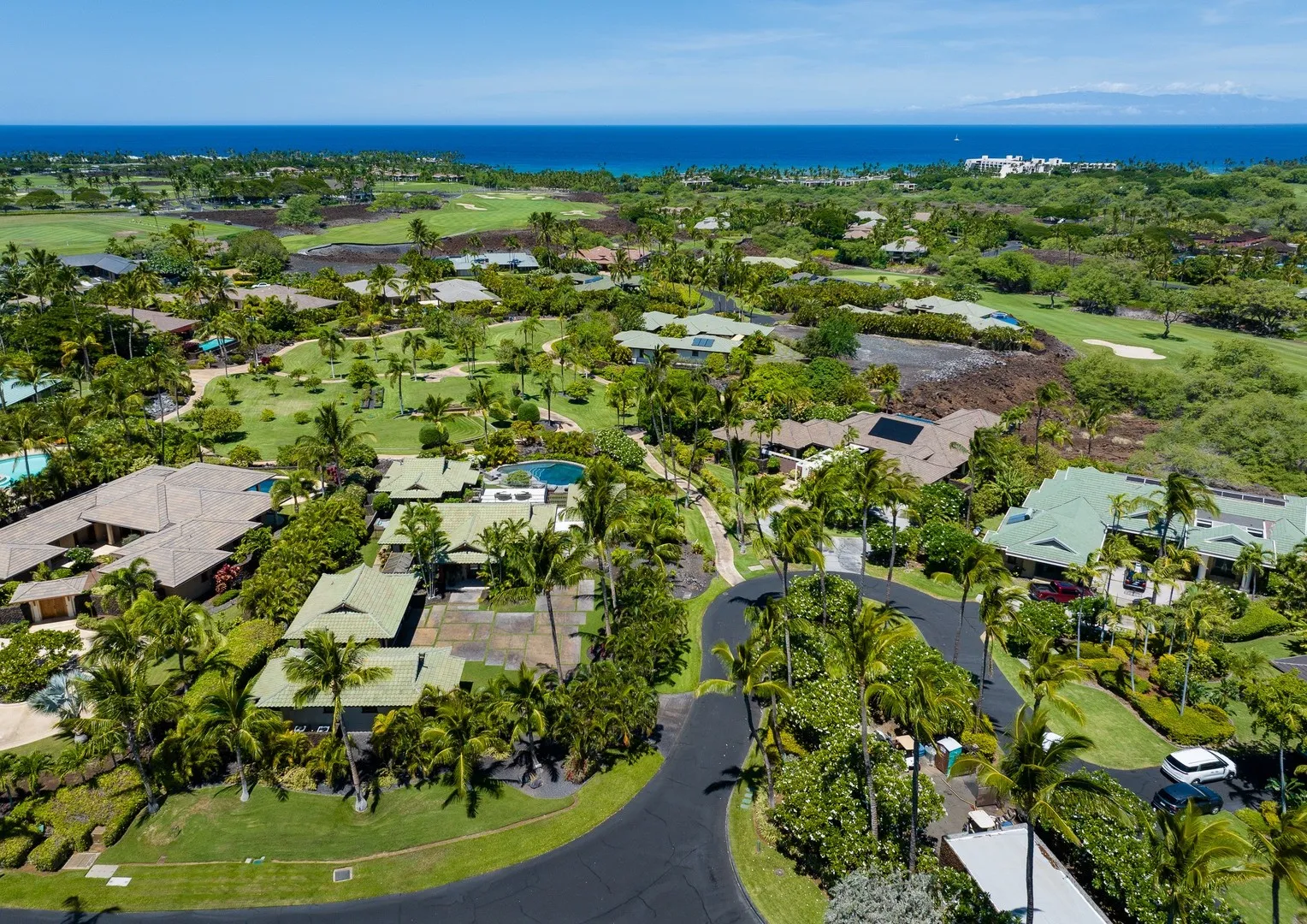
Mauna Lani is one of four resort communities strung along the Kohala Coast on the west side of Hawaii Island, and it is the one most people mean when they picture a Big Island villa holiday: lava fields running down to white sand coves, two golf courses laid over the flows, and a handful of gated residential enclaves where the houses are large, quiet and set well apart.
It is not a single hotel. Mauna Lani Resort covers 3,200 acres on the west side of Hawaii Island and contains two full-service hotels, a private beach club, two championship golf courses, a retail center with a full supermarket, and 17 completed residential developments — some of which are where our Big Island homes actually sit. The whole thing is managed by the Mauna Lani Resort Association, a nonprofit that maintains the common areas.
This guide covers what is there, how it fits together, and the practical things worth knowing before you arrive.
First, about the Kamuela address
Every property at Mauna Lani has a mailing address that reads Kamuela, HI 96743. This confuses almost everyone who looks it up.
Kamuela is the post office name for a ZIP code that covers two very different places: the inland ranching town of Waimea, up at around 2,700 feet in green, cool, misty paniolo country — and the entire sunny, dry Kohala Coast resort strip down at sea level. The postal address says Kamuela. The house is on the coast.
If you search “Kamuela, Hawaii” you will see photographs of pastureland and cattle. That is Waimea town, about a 20-minute drive inland and uphill. Mauna Lani itself is oceanfront, hot and dry, and gets far more sunshine than most of the island.
Where it is, and how long things take
Mauna Lani sits off Highway 19 between mile markers 73 and 74, on the Kohala Coast in the South Kohala district.
- Kona International Airport (KOA) — roughly 30 minutes south
- Waimea town — about 20 minutes inland, for Merriman’s and the farmers’ markets
- Hāpuna Beach and Waialea Bay — 5 to 10 minutes north
- Waikoloa Beach Resort (Queens’ MarketPlace, Kings’ Shops) — about 10 minutes south
- Kailua-Kona town — about 30 minutes south
- Hawaii Volcanoes National Park — a long day trip, roughly 2.5 hours each way
You will need a rental car. The resort is walkable and cyclable within itself, and golf carts are permitted on the streets in some neighborhoods, but there is no meaningful public transport and the properties are spread out. Plan on one car per couple traveling together.
The land, and why it looks like that
Mauna Lani is built on old lava flows, which is why the landscape reads as black rock and manicured green rather than continuous tropical vegetation. The name means “mountain reaching heaven.”
The resort takes its historical character from Kalāhuipuaʻa, the ahupuaʻa — traditional land division — that it occupies. The golf courses are named for Francis H. Iʻi Brown, a Hawaiian sportsman, champion golfer and landowner associated with this stretch of coast, and the resort has preserved a substantial amount of what was here before it.
That preservation is what distinguishes Mauna Lani from the resorts either side of it. Roughly 27 acres of historic preserve sit inside the resort boundary, including an intact complex of ancient Hawaiian fishponds, with one of the largest petroglyph fields in the state just to the north.
The neighborhoods
Mauna Lani is residential in a way most Hawaiian resorts are not. Seventeen completed communities sit within the resort boundary — with three more parcels still in planning or partial construction — ranging from condominium clusters to gated enclaves of custom estate homes.
The ones that matter most for a villa stay:
Champion Ridge
A gated enclave of 33 homesites across 23.5 acres, with 24-hour gated security, laid out along the Mauna Lani North golf course. Lots run to roughly half an acre with a 2,500 sq ft minimum build, so the houses are large and genuinely separated from each other rather than packed shoulder to shoulder.
The position is elevated, which is the point: homes here get fairway, mountain and ocean views rather than sitting flat behind a hedge. Golf carts are allowed on the internal streets, and there is a shared homeowners’ garden of herbs, vegetables and fruit trees. Most homes have their own pool and spa.
It is under a mile to the Mauna Lani Beach Club.
Our homes here include Canoe House, a four-bedroom home in Champion Ridge and its neighbor Beach Walker, which can also be taken together as an eight-bedroom estate sleeping sixteen — useful for two families traveling as one group who still want separate front doors. Champion Ridge 7 and the seven-bedroom Blue Lagoon Estate are also here. You can see all our villas in Champion Ridge in one place.
Pauoa Beach Club
A gated oceanfront community of single-family homes and Na Hale residences set behind Pauoa Bay, adjacent to the Fairmont Orchid at the northern end of the resort. Its defining feature is its own members-only recreation facility on the bay — a 2,000 sq ft fitness center with locker rooms, jacuzzi, sauna, steam room and outdoor massage areas, plus a 100-foot lap pool overlooking Pauoa Bay. That, and direct access to the white sand of Pauoa Bay itself, is why people choose it over the golf-side neighborhoods.
We have Na Hale 3, a three-bedroom villa at Pauoa Beach Club and the five-bedroom Artevilla at Pauoa Beach. Browse everything at Pauoa Beach Club.
One Ocean
Custom estate homes on the golf side of the resort, generally newer construction with larger floor plates than the condominium communities. We list a six-bedroom golf estate in One Ocean — see the full One Ocean selection.
The others
KaMilo, Kulalani, The Villages, Nohea, The Islands, The Fairways, Golf Villas, Mauna Lani Point and Residences of Lauleʻa make up the rest of the resort’s residential stock. These skew toward townhomes and condominiums rather than estate homes — appropriate for smaller parties, less so for a group taking a whole house.
You can see everything we hold across the resort under villas across Mauna Lani Resort.
Mauna Lani Beach Club
The Beach Club is the resort’s private white sand beach, on Makaiwa Bay, with members-only parking and Napua, its own restaurant overlooking the water.
Read this part carefully. The Beach Club is genuinely private — it is not a public beach with a gate. Access runs through the homeowner, not through the resort and not through us, and not every home carries it. Some owners provide Beach Club passes with the rental and some do not; where they do, the number of passes is usually limited.
If Beach Club access matters to your trip, ask about it specifically when you inquire and we will confirm in writing what a given home includes before you book. We would rather tell you it is not included than have you discover it at the gate.
There is public shoreline access elsewhere at the resort. The Mauna Lani Resort Association provides it at three designated locations: Holoholokai Beach Park, the Historic Preserve Public Park, and the 49 Black Sand Beach subdivision. The resort also maintains coastal trails along the shoreline.
Golf
Two 18-hole championship courses, the Francis H. Iʻi Brown North and South, both opened in 1981 and routed directly across the lava.
The South Course is the famous one. Its par-three 15th plays over a lava-rimmed inlet of the Pacific and is one of the most photographed over-water holes in golf. The course generally plays as the more dramatic, links-influenced of the two.
The North Course runs inland through older lava flows and kiawe, with a signature par three set into a natural lava amphitheater. It is the course Champion Ridge sits alongside. Many golfers rate it the better test of the two, if the less photogenic.
There is a pro shop on site, and more courses within a short drive along the Kohala Coast if you want variety across a week.
Mauna Lani Sports & Fitness Club
The resort’s athletic facility: six tennis courts, a 25-meter lap pool, cardio and strength equipment, and separate men’s and women’s shower and steam facilities. Additional courts are available at the Fairmont Orchid and at Mauna Lani, Auberge Resorts Collection.
As with the Beach Club, access for villa guests depends on the individual home’s arrangement — worth confirming at inquiry rather than assuming.
Where to eat
Mauna Lani is unusually well served for a residential resort. You are not driving 40 minutes for dinner.
At Mauna Lani, Auberge Resorts Collection
- CanoeHouse — oceanfront, Japanese-inspired, dinner nightly. The resort’s flagship room and one of the better-known restaurants on the island.
- HāLani — coastal Mediterranean with Hawaiian influences; breakfast through dinner, plus Sunday brunch
- Blue Ribbon Sushi
- Hā Bar — cocktails and lighter plates, lunch and dinner
- Surf Shack — casual beachside, local brews
- The Market — coffee, pastries and sandwiches from 5:30am, which matters when jet lag has you awake at four
- Hale Hoaloha Lūʻau — Friday evenings
At the Fairmont Orchid
- Brown’s Beach House — oceanfront fine dining
- Binchotan Bar & Grill — Asia-Pacific, binchōtan grill
- Hale Kai — casual, beachside, local cuisine
- Orchid Court — breakfast
- Kahakai Bar and Brown’s Deli
At The Shops at Mauna Lani
- Tommy Bahama’s Restaurant & Bar
- Tequilas
- Island Hopper Taproom
- Knead & Bake
- Mauna Lani Coffee Co.
- Juice 101
At the Beach Club
- Napua — for pass-holders, overlooking Makaiwa Bay
Groceries and shopping
The Shops at Mauna Lani on Mauna Lani Drive is the resort’s retail center, and the reason a villa stay here works logistically.
Foodland Farms is a full-scale supermarket — not a resort convenience store. Deli, poke counter, hot bar, produce, the lot. For a group cooking most breakfasts and a few dinners, this is the single most useful thing at Mauna Lani. R. Field Wine Company operates inside it for wine and spirits.
The rest of the center: Tommy Bahama, Hawaiian Island Creations, Beaches Resort Wear, Jams World, Hawaii Mulisha, Jourab Chi Boutique, and Snorkel Bob’s for snorkel and beach gear rental.
For a bigger shop, Waikoloa Beach Resort is 10 minutes south with additional grocery and two more retail centers.
The historic sites
This is the part most guests skip and then wish they hadn’t.
Kalāhuipuaʻa fishponds and trail
An intact complex of ancient Hawaiian fishponds sits inside the resort, connected by a paved loop trail of about a mile round trip with essentially no elevation. The largest pond runs over four acres and reaches close to twenty feet deep. The ponds are historically associated with Kamehameha the Great.
The trail also passes lava tube shelter caves used between roughly 1200 and 1700 AD, and a small number of petroglyphs including the well-known Helmeted Warrior and Fisherman figures. Allow 30 to 60 minutes. Parking is off Pauoa Road.
Puakō Petroglyph Archaeological Preserve
Just north of the resort’s two hotels, this is one of the largest petroglyph fields in Hawaii — a 233-acre preserve holding more than 3,000 carvings, of which around 1,200 are visible from the trail.
The trailhead — the Mālama Trail — is at Holoholokai Beach Park, at the end of Holoholokai Beach Park Road off North Kaniku Drive. The round trip is about 1.2 miles. The district is open daily from 6:30am to 6:30pm.
Go early morning or late afternoon. The midday heat is serious, and low-angle light makes the carvings far easier to see. Wear proper shoes; the path runs through kiawe forest and the thorns are unforgiving on sandals.
Holoholokai Beach Park itself has restrooms, showers, grills and picnic tables, but the shoreline is rocky and it is not a swimming beach.
Beaches at and near the resort
- Makaiwa Bay — the Beach Club beach; white sand, calm, pass-holders only
- Pauoa Bay — fronting the Fairmont Orchid and Pauoa Beach Club
- Holoholokai Beach Park — public, good facilities, rocky entry, not for swimming
- 49 Black Sand Beach — one of the resort’s three public shoreline access points
- Hāpuna Beach State Park — 5 to 10 minutes north; one of the best swimming beaches in Hawaii
- Waialea Bay (Beach 69) — nearby, sheltered, strong snorkeling
Is Mauna Lani right for your trip?
It suits you if: you want a house rather than a hotel room, you’re traveling with family or two couples, you want to cook some meals, you care about golf or want a genuinely quiet base, and you value being able to reach a proper supermarket in five minutes.
It suits you less if: you want to walk to nightlife or a town center, you’re traveling without a car, or you want the lush, rainy, jungle side of the island — that is Hilo and Puna, on the other coast.
For how Mauna Lani compares to Hualālai, Mauna Kea Resort and Kailua-Kona, see our guide to the Kohala Coast’s resort communities. To see everything we hold on the island, browse our luxury villas on the Big Island.
Frequently asked questions
Is Mauna Lani a hotel or a residential community?
Both. Mauna Lani Resort is a 3,200-acre master-planned resort containing two full-service hotels — Mauna Lani, Auberge Resorts Collection and the Fairmont Orchid — alongside 17 completed residential developments, two championship golf courses, a private beach club and a retail center. Villa guests stay in the residential neighborhoods, not the hotels.
Why do Mauna Lani addresses say Kamuela?
Kamuela is the post office designation for ZIP code 96743, which covers both the inland town of Waimea and the coastal resorts of South Kohala. The mailing address reads Kamuela, but Mauna Lani Resort is on the Kohala coastline, about 20 minutes from Waimea town.
How far is Mauna Lani from Kona airport?
Roughly a 30-minute drive north on Highway 19 from Kona International Airport (KOA).
Do villa guests get access to the Mauna Lani Beach Club?
Not automatically. The Beach Club is private, and access is arranged by the individual homeowner rather than by the resort. Some homes include Beach Club passes and some do not, and where passes are provided the number is usually limited. Always confirm in writing before booking.
Do I need a rental car at Mauna Lani?
Yes. The resort is spread out, there is no meaningful public transport, and most guests will want to reach Hāpuna Beach, Waimea and Kailua-Kona during a stay. Golf carts are permitted on the streets within some neighborhoods for getting around the resort itself.
Is there a supermarket at Mauna Lani?
Yes. Foodland Farms at The Shops at Mauna Lani is a full supermarket with a deli, poke counter and hot bar, a few minutes from every residential neighborhood in the resort.
What is Champion Ridge?
Champion Ridge is a gated residential enclave within Mauna Lani Resort — 33 estate homesites across 23.5 acres, with 24-hour gated security, set on elevated ground along the Mauna Lani North golf course. Lots are around half an acre with a minimum 2,500 sq ft build, and most homes have a private pool.
.webp)
.webp)
.webp)